TETRA (TErrestrial Trunked RAdio) is a wireless specification intended to be used by government agencies, public health services, rail transport, military etc. TETRA specification comes from ETSI (European Telecommunication Standards Institute). We plan to start a post series on the building blocks of TETRA physical layer and radio specifications and this is the first post towards that step.
Documents
a) All the standardization documents from ETSI are available online here
b) From the above list, the key document for us to study the physical layer and RF specification is
Doc. Nb. EN 300 392-2 Ver. 3.2.1, Terrestrial Trunked Radio (TETRA); Voice plus Data (V+D); Part 2: Air Interface (AI). Ref. REN/TETRA-03152
Physical Layer Overview
TETRA specification allows for two modulation types
a) Phase Modulation
The overview of the building blocks in phase modulation is as shown below
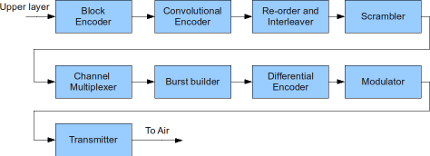
Figure: Overview of TETRA phase modulation (reference Fig 4.1 ETSI EN 300 392-2 Ver 3.2.1)
For phase modulation, based on the data type, the following channel coding schemes are employed
a) Reed Muller (30,14) code or Block Code
b) Rate Compatible Punctured Convolutional code (RCPC)
c) Block Interleaver
d) Scrambler
e) Modulation of Differential Quarternary Phase Shift Keying (
DQPSK) or
Differential 8PSK (
D8PSK)
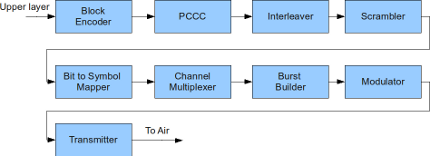
Figure: Overview of TETRA QAM modulation (reference Fig 4.2 ETSI EN 300 392-2 Ver 3.2.1)
For QAM modulation, based on the data type, the following channel coding schemes are employed
a) Reed Muller (16,5) code or Block code
b) Parallel Concatenated Convolutional Code (PCCC)
c) Interleaver
d) Scrambler
e) Modulation of 4-QAM, 16-QAM or 64–QAM
In the upcoming posts in this series we will discuss each of these building blocks in more detail.
Related posts:
- Non coherent demodulation of pi/8 D8PSK (TETRA)
- Non coherent demodulation of pi/4 DQPSK (TETRA)
- Quiz on IEEE 802.11a specifications
Generated by BlogIt
BlogIt - Auto Blogging Software for YOU!


No comments:
Post a Comment